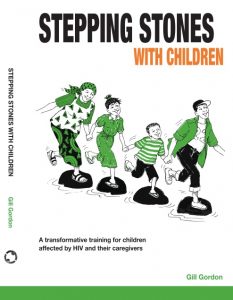
Welcome to "Stepping Stones feedback", the website which explains all about this training package on gender, generation, HIV, communication and relationship skills, and now used by many organisations and communities with whom they work, on all continents around the world

April 2008 - new ACORD report - Implementing Stepping Stones - a practical and strategic guide for implementers, planners and policy makers

December 2007 - see new report on Stepping Stones from the Pacific on the references page

June 2007 - see new video of Kenyan trainers talking about their experiences with Stepping Stones

March 2007 - See NEW RCT results report and policy brief from South Africa MRC Gender and Health Research Unit

Feb 2007 - See new reports and evaluations and link to the optional video/DVD, as well as a Voice of America radio interview, about Stepping Stones and gender violence in South Afica, on the References page.

1 July 2004 - 10th anniversary since the first workshop and still as relevant as ever!


Por información en Español     Pour information en Français

Stepping Stones is a training package in gender, HIV, communication and relationship skills. It is also sometimes described as a life-skills training package, covering many aspects of our lives, including why we behave in the ways we do, how gender, generation and other issues influence this, and ways in which we can change our behaviour, if we want to.

The full title of the original Stepping Stones manual is:
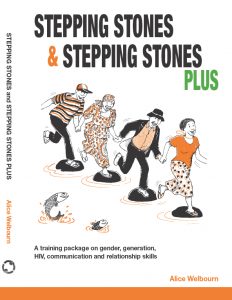
Stepping Stones: A training package in HIV/AIDS, communication and relationship skills by Alice Welbourn 1995, published by Strategies for Hope. ISBN (ISBN 978 0 9549051 7 0). . It is available from TALC or Strategies for Hope. Click here for details of original package.


It is now thirteen years since the first Stepping Stones workshop and the number of communities using this approach is still growing: in Asia, L America, Asia-Pacific and Europe as well as Africa. The training package, promotes gender equity, inter-generational respect and solidarity with HIV positive people, in a human rights framework. It creates supportive, enabling environments where stigma and discrimination would no longer be treatment access barriers. So it is still as relevant as ever.

This website is for people interested in Stepping Stones: to find out what it is and how it works, how it has been adapted, developed and translated. You can also read here about related ideas and other progammes to learn about and think of using.

Click on one of the stepping stones above to find out more…or explore the following topics in brief:

What is Stepping Stones?
Who is it for?
When to run a workshop?
How does it work?
Where have Stepping Stones workshops been conducted?
Findings from Stepping Stones workshops
Back-up support


"...in my estimation one of the most valuable recent additions to the quite scanty written materials available in the area of community mobilization....UNAIDS has included this resource package among the "key documents" recommended for use in innovative community mobilization programmes."
Noerine Kaleeba. Community Mobilization Adviser, UNAIDS. 25.3.97.

(Click here for more comments about Stepping Stones)

What is Stepping Stones?
Stepping Stones is a training package in gender, HIV, communication and relationship skills. It is also a life-skills training package, covering many aspects of our lives, including why we behave in the ways we do, and ways in which we can change our behaviour, if we want to. It consists of a manual and an optional video.

It was originally designed both for use in existing HIV/AIDS projects and in general community development projects which plan to introduce an on-going HIV and sexual and reproductive health component. It was funded by multiple donors and was developed by the Strategies for Hope project, (now an independent trust), which was founded in 1989 with the support of ActionAid.

Stepping Stones is listed by UNAIDS in its recommended resources for community work, by UNIFEM in its Gender and HIV/AIDS web portal, by UNICEF in it technical and policy documents and many others.

The video won the British Medical Association Film Competition Silver Award in 1998. You can see an extract from the film by clicking here. It is also now available on DVD.

Stepping Stones has been distributed to over 1500 organisations in over 100 countries. It grew out of a need to address the vulnerability of women, men and young people in decision-making about heterosexual behaviour. These materials empower people to explore the huge range of issues which affect the sexual health of us all - including gender and age-based roles, money, alcohol or other drug use, traditional practices, attitudes to sex, attitudes to death and our own personalities.

The original package consists of a 240-page manual for trainers (and an optional accompanying workshop video of 15 five-minute clips). There are full, closely-guided instructions on how to run around 60 hours of workshop sessions, divided into 18 sessions over 10-12 weeks. Most sessions are designed for people in small groups of 10-20, of their own gender and age. Occasional sessions bring everyone together. (The optional video, also now available on DVD, is viewed by participants during different sessions of the workshop.)

All the sessions depend on the participants developing their own local analysis of local issues - so local context, culture and history form the basis on which participants can develop their own locally appropriate solutions to the issues which they face.

Stepping Stones is not a quick fix nor a simple solution. Just as people who use Participatory Rural Appraisal or Participatory Learning and Action (PRA/PLA) have emphasised repeatedly, Stepping Stones requires time, good training, skilled facilitation, care, thought, negotiation, prolonged follow-up and more time (See, for instance, the ten myths about PRA in Scoones 1995 in PLA Notes 24, IIED).

In the language of drugs, there is a difference between the efficacy of a drug and its effectiveness. A drug might perform excellently under ideal laboratory conditions, but how easily can it be used in the real world, where a huge range of factors may influence whether and how people might be able to take it? It is the same with Stepping Stones. Under the initial "laboratory" conditions of a community in rural Uganda, with highly experienced facilitators, trusted by a well-mobilised and motivated community, the village participants reported some remarkable changes after the workshop.

But how much are these changes replicable elsewhere in different cultures, with less able facilitators, with less locally suitable adaptations, with more fluid or urban residential units, with people of different sexual orientations…? A huge range of different factors can influence the transfer of a package such as this from one context to another.

Fortunately the package has now been widely adapted and many similar postive findings have emerged from very different contexts and cultures. This website aims to help you see how the package works and decide for yourself whether it might be of use to you.

Click here for references page to see how Stepping Stones has worked in different contexts.

Back to contents for this page.

Who is it for?
The package is designed to enable women, men and young people of all ages to explore their social, sexual and psychological needs, to analyse the communication blocks they face, and to practise different ways of addressing their relationships. The workshop aims to enable individuals, their peers and their communities to change their behaviour - individually and together - through the "stepping stones" which the various sessions provide.
Click here for references page to see how Stepping Stones has worked in different contexts.

Planned originally for use in communities throughout sub-Saharan Africa, the package has now also been adapted for use elsewhere in Africa, in Asia, in Europe and further. It has been used successfully with groups of HIV positive people and with groups of people who are HIV-ve or who do not know their status. The whole package is based on a human-rights based approach, assuming that we all share certain challenges in our lives, irrespective of our HIV status, which the package aims to help us address.

It is designed for a team of skilled facilitators - ideally two male, two female - who work with groups in small-scale settings. Facilitators experienced in working on sexual and reproductive health (SRH) issues, in gender training and in participatory non-formal learning approaches could use the material straightaway.
Click here for more detailed information on 'Who'.

Back to contents for this page

When to run a workshop?

When to run a Stepping Stones workshop can have a big influence on its effectiveness. It is often very helpful to conduct seasonal calendar exercises with different groups of community members beforehand, in order to find out from them which time of year they are least busy and it may be least difficult for them to attend.

On these webpages the ages of participants are considered. The importance of ensuring that peer group meetings fit in with the commitments of members of each peer group separately is also discussed, rather than trying to get all the peer groups to meet at the same time. Regular attendance at meetings is seen to have its advantages.

Finally it is explained that it is crucial for participants to continue with other exercises and activities in the community once they have finished the Stepping Stones workshops, in order to maintain the momentum of the changes they seek to make in their lives. Click here to see details of these points.

Back to contents for this page

How does it work?
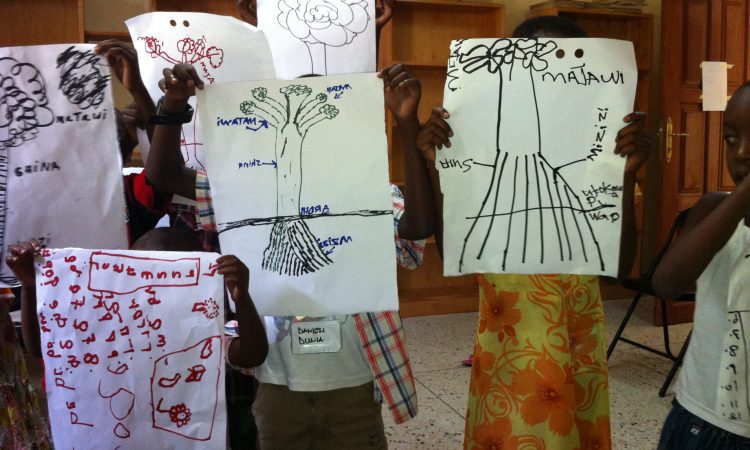
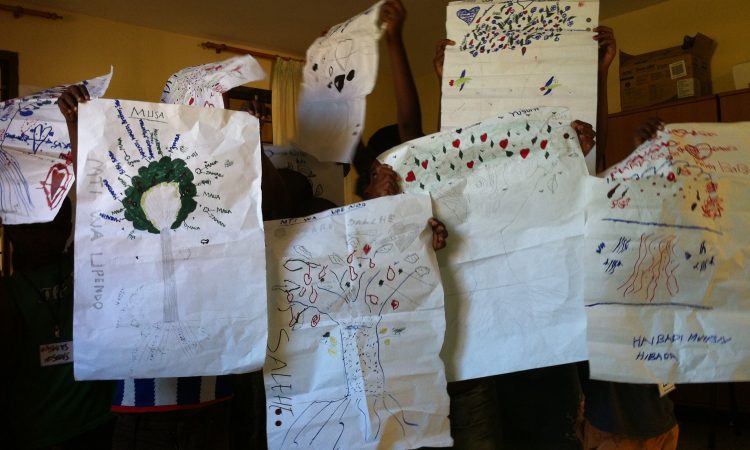
Stepping Stones workshops can create a supportive enabling environment for everyone. All sessions use a participatory approach of non-formal learning through shared discussions and accompanying creative activities. All exercises are based on participants' own experiences. Role play and drawing exercises enable everyone to take part: no literacy is needed. Participants discuss their experiences, act them out, analyse them, consider alternative outcomes, develop strategies for achieving them and then rehearse these together in a safe, supportive group.

People feel safe because most sessions take place in groups of their own gender and age, with facilitators of the same gender and similar age. Participants also enjoy the sessions because there is a lot of fun and laughter as well as the more challenging work.
Click here for more detailed information on 'How'.

Click here for references page to see how Stepping Stones has worked in different contexts.

Back to contents for this page

Where have Stepping Stones workshops been conducted?

If you click here, you can find out in which countries and contexts Stepping Stones is being used; what different language translations already exist; and which countries have made local adaptations of Stepping Stones.

Click here for references page to see how Stepping Stones has worked in different contexts.

Back to contents for this page

Findings from Stepping Stones workshops

The training package, promotes gender equity, inter-generational respect and solidarity with HIV positive people, in a human rights framework. It creates supportive, enabling environments where stigma and discrimination would no longer be treatment access barriers. So it is still as relevant as ever. We have described the findings from successfully run workshops like a wheel of change, which needs to keep turning for changes to be sustained. Learning and sharing are important first steps, but what we also look for are signs of caring and changing. In particular we look for signs, not just of women as the carers, but of young men starting to care for others, and for shifts in gender equity, such as reduction in gender violence, increased harmony and sharing of household costs and tasks, greater mutual respect between genders and generations, an increase in condom use... and so on.

But of course Stepping Stones is only a first step. Other activities need to continue in the community once the Stepping Stones workshop is finished, in order for the wheel of change to continue to turn. Community members also need to be supported with user-friendly health, legal, financial and other services. You can read more about our findings and about wider support services on the references page.

Click here to see findings drawn by an older women's group in Uganda

Click here for references page to see how Stepping Stones has worked in different contexts.

Back to contents for this page

Back-up support
On this website, if you click on the other pages, you can read about other organisations' adaptations and uses of Stepping Stones. We also recommend that you download guidelines for adaptation of the package to suit your own needs, and training guidelines, in case you want to develop a pool of experienced facilitators.

New modules on STIs, pregnancy, sexual turn-ons and turn-offs, gender violence, coping with grief, developed by other organisations in their adaptations of the original manual, can be found in the appendix to the adaptation guidelines.

Back to contents for this page


Stepping Stones is part of the Strategies for Hope series

This web site kindly funded by the Exchange Programme

| Who & When| | Issues | | How | | Where | | References | | Home |

email: mail@steppingstonesfeedback.org

© copyright Alice Welbourn 2002, 2003, 2004

thanks to Petra Röhr-Rouendaal for her illustrations

web site designed by Alice Welbourn with the assistance of Quay Press